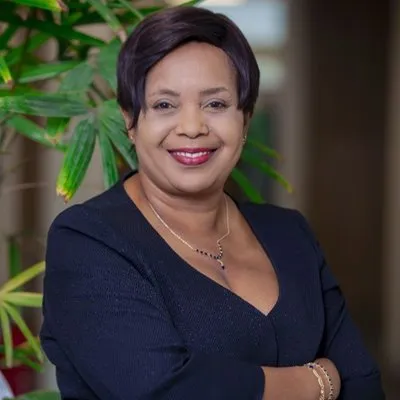
Marie-Chantal Uwanyiligira
Division Director for Côte d’Ivoire, Benin, Guinea & Togo World Bank
After four years of service in Madagascar, Marie-Chantal Uwanyiligira is taking over as Division Director for the World Bank in Côte d'Ivoire, Benin, Guinea, and Togo. A Rwandan national and economist by training, Marie years of experience in the field of development. Having joined the World Bank in 1995 as Operations Officer in Kigali, Rwanda, she rose through the ranks and held key positions within the institution, including: (i) World Bank Resident Representative in Madagascar; (ii) Head of Service at the Global Center of Expertise for the Water and Sanitation Department; (iii) Assistant and then Deputy Chief of Staff to the President of the World Bank Group in Washington; (ii) Chief of Staff to the Managing Director of the World Bank; (iv) Program Coordinator for Senegal, Cape Verde, Gambia, Guinea-Bissau, and Mauritania. She also has experience in the private sector, having held management positions while sharing her knowledge as a teacher at several universities. Marie-Chantal Uwanyiligira holds a master's degree in economics and business management.
2026 Agenda Sessions
Powering the future – The World Bank Group’s support to Africa’s minerals and metals
This Industry Intel Session will spotlight the World Bank Group’s minerals and metals approach and its holistic, multisectoral support to Africa’s mining and energy transition priorities. The discussion will explore how Africa’s mineral endowment can be transformed into broad-based and lasting development through responsible exploration and production, improved governance, investment in critical infrastructure, value addition, skills development, and meaningful private-sector engagement.
Through a high-level dialogue between government representatives, industry leaders, investors, and the World Bank Group, the session will examine practical pathways to collaboration and delivery. Panelists will discuss what success looks like from their perspectives, where support is most needed, and how public and private actors can jointly shape competitive, resilient, and inclusive mineral value chains across the continent.
The session will feature a forward-looking conversation informed by real implementation experience, case examples, and market developments. It will help define priorities, highlight opportunities, and reinforce partnerships that position Africa as a leader in the global energy transition.
Monday 09 February 13:45 - 15:15 Serengeti Stage (CTICC2 - Level 3)
This Industry Intel Session will spotlight the World Bank Group’s minerals and metals approach and its holistic, multisectoral support to Africa’s mining and energy transition priorities. The discussion will explore how Africa’s mineral endowment can be transformed into broad-based and lasting development through responsible exploration and production, improved governance, investment in critical infrastructure, value addition, skills development, and meaningful private-sector engagement.
Through a high-level dialogue between government representatives, industry leaders, investors, and the World Bank Group, the session will examine practical pathways to collaboration and delivery. Panelists will discuss what success looks like from their perspectives, where support is most needed, and how public and private actors can jointly shape competitive, resilient, and inclusive mineral value chains across the continent.
The session will feature a forward-looking conversation informed by real implementation experience, case examples, and market developments. It will help define priorities, highlight opportunities, and reinforce partnerships that position Africa as a leader in the global energy transition.
What lessons can we learn from Guinea’s use of partnerships in realising its iron ore potential?
Guinea holds some of the largest untapped high-grade iron ore reserves in the world, particularly in the Simandou range, a deposit that has long been seen as a game-changer for the global steel industry and for West Africa’s economic future. But unlocking this potential has proven complex, with decades of delays, geopolitical entanglements, infrastructure challenges, and shifting global demand. This session will examine lessons learnt, the power of partnerships, and what lessons can be extrapolated?
Tuesday 10 February 15:45 - 16:30 Ngorongoro Crater Stage (CTICC1 - Level 2)
Critical minerals
Infrastructure and industrialisation
Guinea holds some of the largest untapped high-grade iron ore reserves in the world, particularly in the Simandou range, a deposit that has long been seen as a game-changer for the global steel industry and for West Africa’s economic future. But unlocking this potential has proven complex, with decades of delays, geopolitical entanglements, infrastructure challenges, and shifting global demand. This session will examine lessons learnt, the power of partnerships, and what lessons can be extrapolated?
Ngorongoro Crater Stage (CTICC1 - Level 2) Africa/Johannesburg


-Logo_CMYK_1.jpg?width=1000&height=500&ext=.jpg)


.png?width=300&height=208&ext=.png)

_mi25-weblogo.png?ext=.png)

_1.png?ext=.png)


_logo.png?ext=.png)


_mi25-weblogo.png?ext=.png)