News & Media
Featured
South Africa’s Eskom indicates positive outlook for winter period
Monday, May 19, 2025
He addressed the trend of industrial energy users adopting onsite generation and explored future collaboration opportunities between Eskom and mining companies.
Marokane highlighted the potential for mines to sell energy back to the grid, Eskom's strategies for balancing revenue needs with demand-side management, and the outlook for load-shedding in the short to medium term.
He also touched on electricity price stability amid tariff hikes, Eskom's role in supporting downstream manufacturing in South Africa, and key strategies to future-proof Africa's mining industry.
Key points outlined by Marokane included:
- Collaboration with mining companies on onsite generation and energy sales
- Balancing revenue needs with demand-side management
- Load-shedding outlook in the short to medium term
- Electricity price stability amid tariff hikes
- Support for downstream manufacturing in South Africa
- Strategies to future-proof Africa's mining industry
The Minerals Council South Africa has just released its latest Economic Insights Report – Electricity update: March to April 2025, providing crucial information as to the status of Eskom’s ambitions.
The report underscore that the Energy Availability Factor (EAF) declined slightly to 56.4% in April, from 57.5% in March. For Eskom’s 2025 financial year (April 2024 to March 2025), the EAF averaged 61.2% - an improvement from 54.9% recorded in the 2024 financial year (April 2023 to March 2024), which included some of South Africa’s worst loadshedding.
While the 61.2% outcome marks progress, it remains well below Eskom’s 70% target. Unplanned breakdowns in the first four months of 2025 have led to intermittent loadshedding to maintain system stability. The supply-demand margin remained tight in April.
Average electricity demand was 22,310 MW, slightly exceeding dispatchable generation of 22,272 MW. Eskom has also just released its winter outlook and the utility’s baseline is for no loadshedding during the winter months. Importantly, this is if unplanned outages remain below 13,000 MW.
Figure 1: Historical Eskom EAF
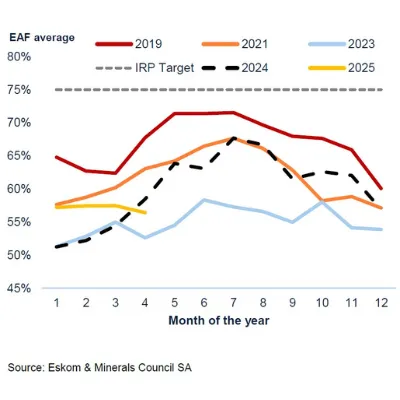
However, if unplanned losses reach 15,000 MW, Eskom anticipates up to 21 days of stage 2 loadshedding. Higher stages may be needed briefly - particularly on weekends - to avoid weekday disruptions.
Eskom also warned that in areas with widespread illegal connections, load curtailment may be enforced. This will not be due to generation shortfalls, but to protect infrastructure from overload.
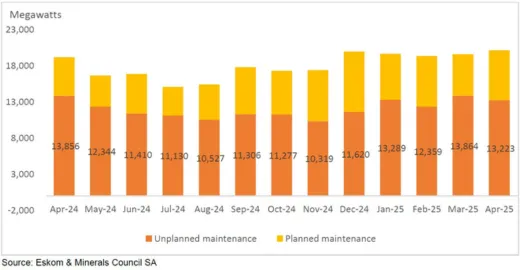
The chart below provides context on the past year’s planned and unplanned outage levels to help evaluate the credibility of these winter assumptions.
Figure 2: Eskom Unplanned Maintenance (outages) & Planned Maintenance
-Planned-Maintenance.webp?language=en "South Africa’s Eskom indicates positive outlook for winter period - Eskom Unplanned Maintenance")
Over the past 13 months, unplanned outages breached the 13,000 MW mark on four occasions but did not exceed 14,000 MW. This track record suggests that Eskom’s assumption of unplanned outages remaining between 13,000 MW and 15,000 MW is not only reasonable but well-grounded based on its recent performance.
While the electricity system will likely remain under strain, the trend in breakdowns indicates that, barring a black swan event, it is unlikely that outages will increase to more than 15,000 MW that would necessitate significant loadshedding.
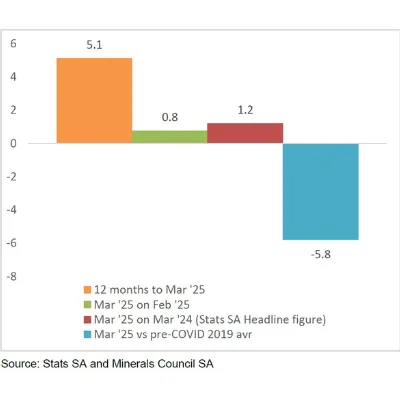
Figure 3: Variation in Electricity Produced (%, seasonally adjusted) – All Producers
-%E2%80%93-All-Producers.webp?language=en "South Africa’s Eskom indicates positive outlook for winter period - Variation in Electricity Produce")
Data released by Stats SA on 6 May shows that seasonally adjusted real electricity generation rose by 1.2% year-on-year in March 2025. Month-on-month, output increased by 0.8% compared to February. On average, over the 12 months to March 2025, electricity production was up 5.1% relative to the previous year. With March completing the first quarter’s data, electricity generation grew by 2.4% year-on-year in Q1 2025.
However, due to the decline in the EAF in Q1 2025, electricity production fell by 2% compared to Q4 2024 - meaning the sector will likely subtract from GDP growth in the first quarter of the year.
RELATED: The relationship between Eskom and the mining industry
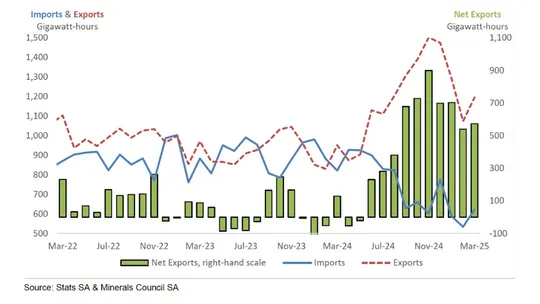
Eskom estimates that its electricity sales volumes grew by 3.6% in the 2025 financial year, largely due to reduced loadshedding and higher export volumes - both of which contributed much-needed revenue for the utility. The chart below shows electricity exports and imports across all producers in South Africa, with exports primarily driven by Eskom.
Figure 4: Imports and Exports of Electricity
April marked the start of Eskom’s 2026 financial year, which began with a 12.74% electricity tariff increase for direct customers. While the utility recorded notable improvements in the Energy Availability Factor and reduced diesel usage during FY2025, these gains followed a period of historically poor performance in 2023/24 (FY2024). Despite the progress, Eskom still fell short of the 70% EAF target set for its coal-fired fleet in FY2025, with the EAF averaging 61.2% for the year.
Nonetheless, the utility has made steady progress through extensive maintenance efforts. Two units at Kusile (1,600 MW) were returned to service in January, with the third – Unit 6 – now synchronised and set to add a further 800 MW once it enters commercial operation.
Additionally, Koeberg Unit 1 (930 MW) has been brought back online, and Medupi Unit 4 (720 MW) is expected to return during the winter months. These capacity recoveries support Eskom’s positive outlook for the winter period. While risks remain, particularly given the still-tight supply-demand balance, the power system enters winter 2025 in a more resilient position than in recent years.
Market News
Related articles
.webp?language=en)
Articles
Tuesday, October 6, 2026
Gabon’s Milingui iron project moves towards production
After decades of waiting, construction activity is giving new momentum to one of Gabon’s largest iron-ore opportunities.
.webp?language=en)
Articles
Tuesday, October 6, 2026
Africa’s critical minerals: The opportunity of a generation
Geopolitics is fundamentally reshaping the global economy, and nowhere does that shift have greater impact, both in terms of challenges and opportunities, than Africa.
.webp?language=en)
Articles
Monday, October 5, 2026
A new partnership for the DRC’s critical minerals future
What does the Buenassa Deal signal for the DRC’s critical minerals strategy?










-ltd-a325b1d3-6414-476b-9b7e-20c2285d5a51.webp?language=en)

-Primary-Logo.webp?language=en)