News & Media
Featured
Mine 2026: Capital in motion
Thursday, July 9, 2026
What's in this article
This is an excerpt from PwC's Mine 2026: Ambition to action report.
Mining captures only a small part of the annual US$3.3 trillion of global investment in energy and related industries. Mining development capital—the investment that creates new supply—stood at approximately US$55 billion in 2024. That’s less than one-eighth of the amount invested in solar photovoltaics and less than one-tenth of what was spent on data centre construction—two industries heavily dependent on mining.
Forecasts by PwC and Oxford Economics indicate that these investment gaps will persist. They show that while
annual investment in metals and mining infrastructure will rise by 39% from 2024 to 2050 to reach US$128 billion, outlays on renewables will climb 52%.
The gap, we’d argue, is structural, not cyclical. Mining projects, as a class, present common failure points. When considering new projects, investors test for these potential weaknesses by evaluating three investability conditions:
1. A credible risk-adjusted return relative to private sector hurdle rates. Mining development commands a materially higher return premium than many comparable capital-intensive sectors, reflecting the combination of
long development timelines, permitting risk, processing exposure, and the fundamental geological uncertainty. A project that would attract capital at a 7% return as a solar farm or at 10% as a nuclear plant won’t be attractive as a mine.
2. A structured path to secure cash flow. Copper and magnet rare-earth elements are the most critical minerals to energy transition and defence applications. But no mechanism currently exists that converts future
production to secure cash flow with the consistency and scale required to unlock institutional debt and equity markets. Price floors, strategic offtake guarantees, and demand commitments can fill this role.
3. A jurisdiction with a supportive permitting and processing access profile. A mineral deposit can’t be relocated to a more favourable jurisdiction, which means the environment must be supportive. The Resolution Copper project, a proposed mine in Arizona, illustrates the challenge. A tier 1 asset in a tier 1 jurisdiction, it had US$2 billion of committed development capital but didn’t reach a final investment decision because permitting wasn’t structurally resolved before seeking capital.
Investors must also assess the challenges and opportunities associated with the value chains and end markets for individual minerals. Converting abundant copper reserves into producing mines at returns acceptable to institutional capital has become structurally more difficult with every project generation. Gold, meanwhile, trades on deep, liquid markets; central bank demand provides a structural floor; debt markets function well; and institutional equity is abundant. Yet big miners deploying record cash flows consistently choose M&A over greenfield exploration. The industry reported no major gold discoveries in both 2023 and 2024, down from more than 20 per year through the 1990s.
Then there are magnet rare-earth elements—such as neodymium, praseodymium, dysprosium, and terbium that serve as critical inputs for electric vehicle motors, defence systems, and wind turbines. Since deposits of these minerals are concentrated in China, governments and companies elsewhere must either manage difficult relationships with Chinese counterparties or invest substantially in exploration in untested geographies.
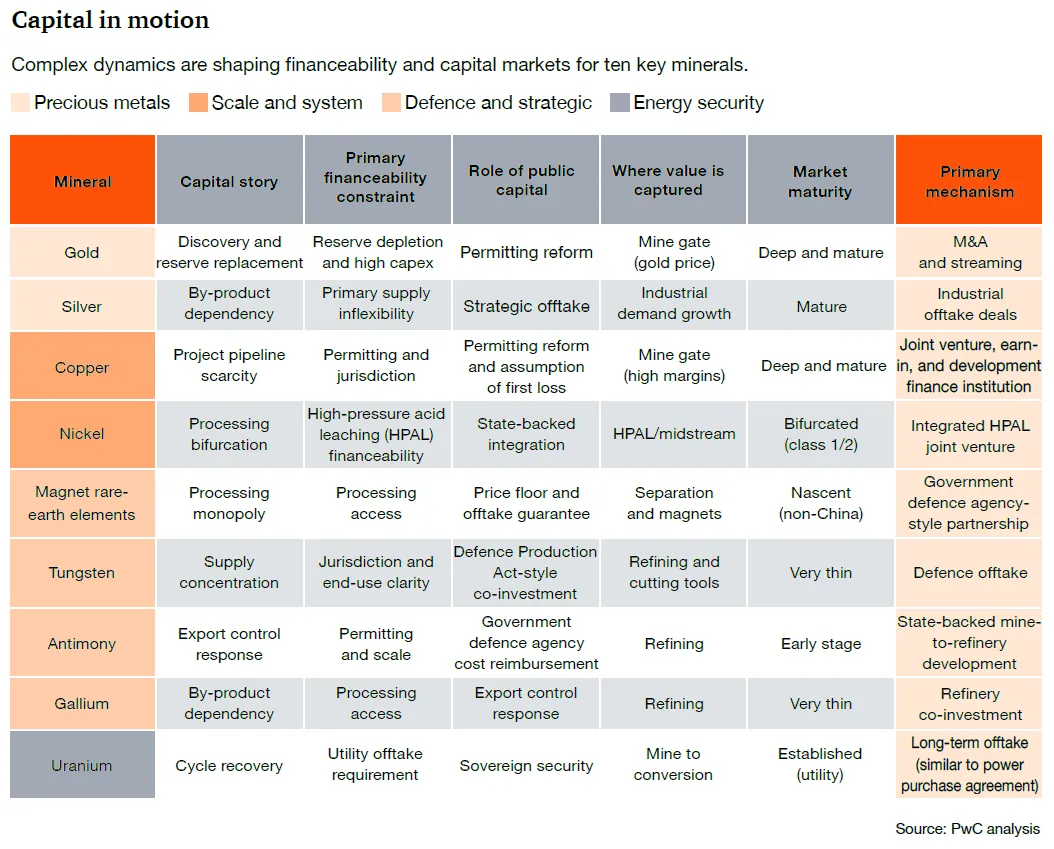
There’s an additional challenge: the absence of a single mining capital market. As the chart below shows, each mineral operates under a distinct capital logic, investability constraint, and value chain dynamic.
Mapping the risk curve
Mining capital operates through two distinct ecosystems. In the first, large miners fund development from their own balance sheets. In the second, independent developers must attract external capital from investors with explicit mandate constraints. The structural funding gap is a feature of the second ecosystem only. This makes it often necessary for independent developers to piece together funding from various sources from stage to stage. Understanding how access to capital can shift over the course of a development is vital to getting new projects through to production.
The chart below shows where each financing instrument operates across the development life cycle, illustrating where those conditions are met and where they fall short.
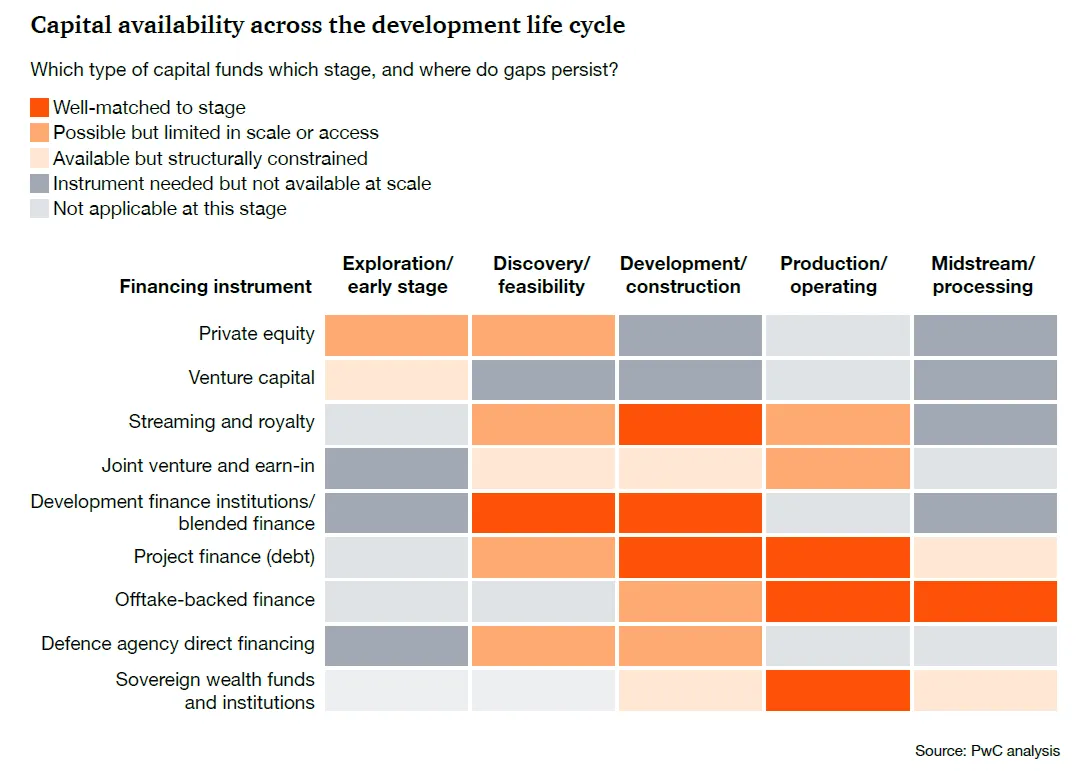
The chart shows a pronounced funding gap during the exploration and discovery/feasibility stages. This is precisely where the investment decisions that determine future supply are made and where only Development Finance Institutions (DFIs) and blended finance structures offer coverage. The valley of death lies between initial discovery and the final investment decision, when a project requires the most capital to prove its geology, complete feasibility studies, and secure permits, but where the absence of contractable cash flows means institutional capital won’t yet commit.
Financial coverage is broadest at the production and operating stage, where assets generate cash, debt can be serviced, and institutional mandates best align with miners’ deployment needs. In the midstream/processing stage, gaps persist regardless of the financing instrument, reflecting a market infrastructure problem due to the absence of price benchmarks, financing templates, and transaction history that institutional mandates require. In the development and construction stage, project finance debt and joint venture capital operate selectively, while
venture capital and private equity have largely withdrawn.
Structures that move capital
The challenge of securing conventional equity and debt is particularly acute until miners can convince investors that a project will generate positive cash flows.Now, however, developers are using novel structures to create the contractual certainty that private markets can’t generate alone. These include:
Joint ventures and earn-in provisions substitute a large miner’s credit quality for the developer’s investment profile. The Filo del Sol/Vicuña arrangement is a 50-50 joint venture formed between BHP and Lundin Mining to hold assets located on the Chile-Argentina border. BHP is providing the depth of financial resources to make the project—whose capital cost for the first of three contemplated phases is about US$7 billion—possible on the current timeline.
Streaming and royalty financing arrangements offer an alternative approach to financing for developers who can’t access sufficient conventional equity or project debt. Under a streaming arrangement, the investor provides upfront capital in exchange for the right to purchase a share of future production at a pre-agreed price. Under a royalty arrangement, the investor receives a percentage of revenues or net profit without a fixed purchase price.
In both cases, the royalty or streaming company primarily assumes commodity price exposure, rather than construction cost risk. The developer receives nondilutive capital without the mandate constraints of institutional equity. Streaming and royalty companies, many of which are based in Canada, have led the development of these instruments. They typically deploy capital at the exploration stage, at a point where conventional project finance may not commit funding. The instrument works because the royalty company’s diversified portfolio can absorb project-level risk that a single-asset lender can’t take on.
Offtake-backed and state-backed financing are the only mechanisms that directly address the path to contracted cash flow. Export Finance Australia’s AU$1.65-billion non-recourse facility for Iluka Resources’ Eneabba rare-earth refinery follows the same logic. The Australian government provided debt that the private market wouldn’t supply. Without a processing facility already in operation, there was no revenue history to lend against. Similarly, the US International Development Finance Corporation structured a US$1.8-billion first-loss commitment through the Orion Critical Mineral Consortium for critical minerals projects. A first-loss position means the public institution absorbs the initial portion of any losses before private investors are affected, directly reducing the effective risk that private capital must price.
In another example, the US Department of Defense’s commitment to MP Materials—combining price floors, cost-reimbursement contracts, and strategic procurement guarantees—converted an uncertain revenue stream for rare-earth elements into a secure one, unlocking US$1.5 billion in private capital at a leverage ratio of 1.6.
The challenge now is to bring scale to such efforts, and the work falls on both sides. For miners, the critical shift is sequencing: they must resolve investment conditions before seeking capital, not after. Miners that cross the investment threshold build contract certainty into their proposition before they enter an investor meeting. For governments, the most powerful lever is in creating investment certainty, rather than providing direct capital, through price floors, strategic offtake guarantees, and permitted project pipelines that convert uncertain commodity cash flows into contracted streams. Governments that de-risk rather than replace private capital can multiply the impact of private investment and get more resources deployed faster and at a lower cost to the public.
Mine 2026: Ambition to action
The full report can be downloaded here
AUTHOR: Sacha Winzenried I Energy, Utilities, and Resources, PwC Indonesia
Contributors:
Andrew Jenkins, Partner , PwC Indonesia
Matthew Williams, Director , PwC United Kingdom
Exploration & Junior Mining Companies
Major & Mid-Tier Mining Companies
Investors
Critical & Strategic Minerals
Energy
Geopolitics
Exploration
Investment
Related articles

Wednesday, November 12, 2025
Africa’s Critical Minerals: the decade that will define global power
As the US–China rivalry deepens, Africa’s mineral wealth is emerging as both opportunity and leverage. The next ten years will determine whether the continent remains a source of raw materials - or becomes an industrial power in its own right.
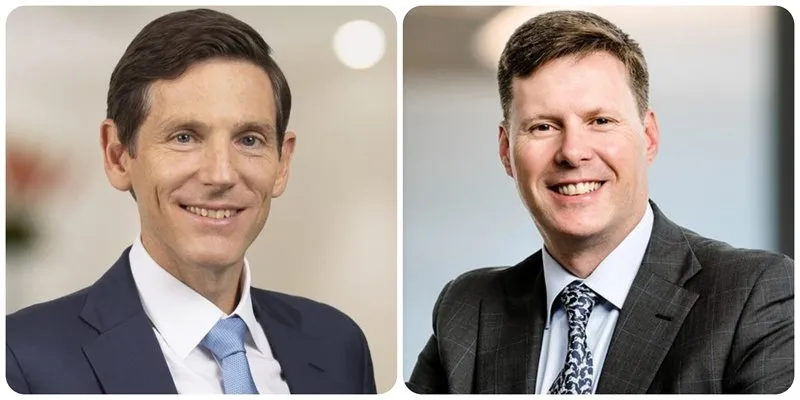
Monday, November 10, 2025
All eyes on Anglo Teck following “once-in-a-generation” agreement
The announcement that Anglo American and Teck Resources will merge in a $53 billion transaction marks one of the most consequential mining deals of the 21st century.

Sunday, November 9, 2025
Beyond compliance: co-creating a lasting social license to operate in mining
Mining plays a critical role in society by providing essential raw materials that support a wide range of industries and products.









-ltd-a325b1d3-6414-476b-9b7e-20c2285d5a51.webp?language=en)


-Primary-Logo.webp?language=en)